
You Can’t Make People Engaged… But You Can Create the Conditions for Engagement
One of the most common questions I hear from leaders today is:
“How do I engage my people?”
There’s an interesting paradox in that question.
Because you can’t actually make someone engaged.
In my experience, you need to energise people so that they choose to become more engaged.
And one of the most powerful human energisers I’ve encountered throughout my career is purpose.
I was with a client recently who told me about a rush turnaround job they had needed to complete for a customer.
The whole team rallied around it.
Everyone pulled their weight. People worked together. They helped one another. There was urgency, camaraderie and a collective determination to get the job over the line.
You could visibly see his excitement as he described what his team had achieved.
I told him:
“What you’ve just described is a micro-purpose in action.”
For that period of time, everybody knew exactly why they were doing what they were doing. They had a common objective that mattered, a challenge to overcome together and immediate feedback on whether they were succeeding.
They didn’t need an employee-engagement initiative.
They had something worth engaging in.
I've built high-performing business teams across three continents, led large divisions, worked with hundreds of client businesses and built teams within my own SMEs.
Across all of that experience, one principle has remained remarkably consistent:
“Performance is a by-product of purpose. Period.”
Give people a sufficiently meaningful purpose, involve them in it and allow them to see progress, and something changes.
Energy increases.
Collaboration increases.
Initiative increases.
And engagement often follows.
I've given thousands of people pay rises and performance improves for anything from two days to two weeks. Money matters, of course, but its motivational effect can quickly become normalised.
Purpose can continually renew itself.
Macro-purpose isn't enough
Every organisation should have a compelling overarching purpose.
That macro-purpose should underpin the organisation's culture and answer some big questions:
Why do we exist?
What are we trying to achieve?
What do we stand for?
But there is a problem.
The macro-purpose doesn't always translate into Tuesday afternoon.
It can become too distant from someone's day-to-day work to continually influence behaviour.
That's why I believe so strongly in creating micro-purposes.
A micro-purpose gives a team a compelling reason to come together around something that matters now.
I've used them around projects, sites, departments, customer challenges, quality improvement, process improvement, breaking down silos and major organisational change.
The psychology is fundamentally the same:
Purpose → Collective Consciousness → Involvement → Action → Momentum → Performance
Then you create feedback loops so people can see the difference they're making.
Do that repeatedly and you begin to create a very different working environment.
One of the most powerful micro-purposes: your internal customer
Ask almost anybody in a business:
“Do you believe in satisfying your customers?”
Almost everyone will say yes.
But think about the word satisfactory.
In most five-point rating systems, satisfactory is somewhere around 3 out of 5.
Is that really the aspiration?
I encourage teams to think instead about creating the WOW factor.
I start externally:
“What experience do our customers have as a result of dealing with us?”
People understand that immediately.
Then I change one word:
“What experience do our internal customers have as a result of dealing with us?”
That usually creates a very different conversation.
Your internal customer is the next person, team or process downstream from what you do.
If you're completing timesheets, for example, somebody downstream needs that information to be complete, accurate and on time so that payroll, job costing or customer invoicing can happen properly.
What experience do they have because they dealt with you?
Five out of five?
The WOW factor?
Or would they sometimes struggle to give you satisfactory?
Suddenly, customer service is no longer the responsibility of the customer-service department.
Everyone is in customer service.
And when each person becomes focused on creating an exceptional experience for the next person in the chain, the external customer experience improves as a consequence.
It also gives people another purpose bigger than simply completing their own tasks.
Purpose can also break down silos
This is where micro-purpose becomes particularly powerful.
Silos encourage people to ask:
“What does my department need?”
A strong collective purpose changes the question to:
“What are we collectively trying to achieve, and what does the business need from me to achieve it?”
That's a profound difference.
I've used this principle with projects, departments, shifts, sites and entire businesses.
You can create micro-purposes around:
- delivering an exceptional customer experience;
- achieving net zero;
- improving quality;
- eliminating waste;
- improving a process;
- solving a customer problem;
- completing a major project;
- improving safety;
- developing the next generation of talent.
The subject changes.
The human psychology doesn't.
Create a compelling why. Involve people in determining how. Give them ownership. Make progress visible. Recognise contribution. Then repeat.
Micro-purpose needs micro-culture
There is one final piece.
You cannot continually create high-performing teams through isolated bursts of motivation.
Your overall organisational culture, the macro-culture, underpins everything.
And if that culture isn't strong enough, eventually the cracks appear as the organisation grows.
But just as macro-purpose can sometimes feel distant from someone's daily work, macro-culture needs to be translated into something meaningful at team level.
That's why I teach leaders to deliberately develop micro-cultures within their teams, departments and divisions.
Not separate cultures that compete with the organisation.
Micro-cultures that deliberately cascade from and reinforce the macro-culture.
And here's where it becomes particularly powerful:
Don't simply tell people what their micro-culture should be. Involve them in creating it.
What do we stand for as a team?
What experience do we want others to have when dealing with us?
What behaviours will we hold ourselves accountable for?
How will we support one another?
What are we collectively trying to achieve?
Now you are developing much more than engagement.
You're developing self-leadership, ownership and accountability.
When every team in an organisation understands the macro-culture, develops its own aligned micro-culture and continually creates micro-purposes that give people something meaningful to rally around, something powerful happens.
You stop continually asking:
“How do I get my people engaged?”
And start asking a much better leadership question:
“What conditions am I creating that make people want to engage?”
Because engagement isn't something you do to people.
Create purpose. Create ownership. Create momentum. Energise people, and give them a reason to choose engagement.
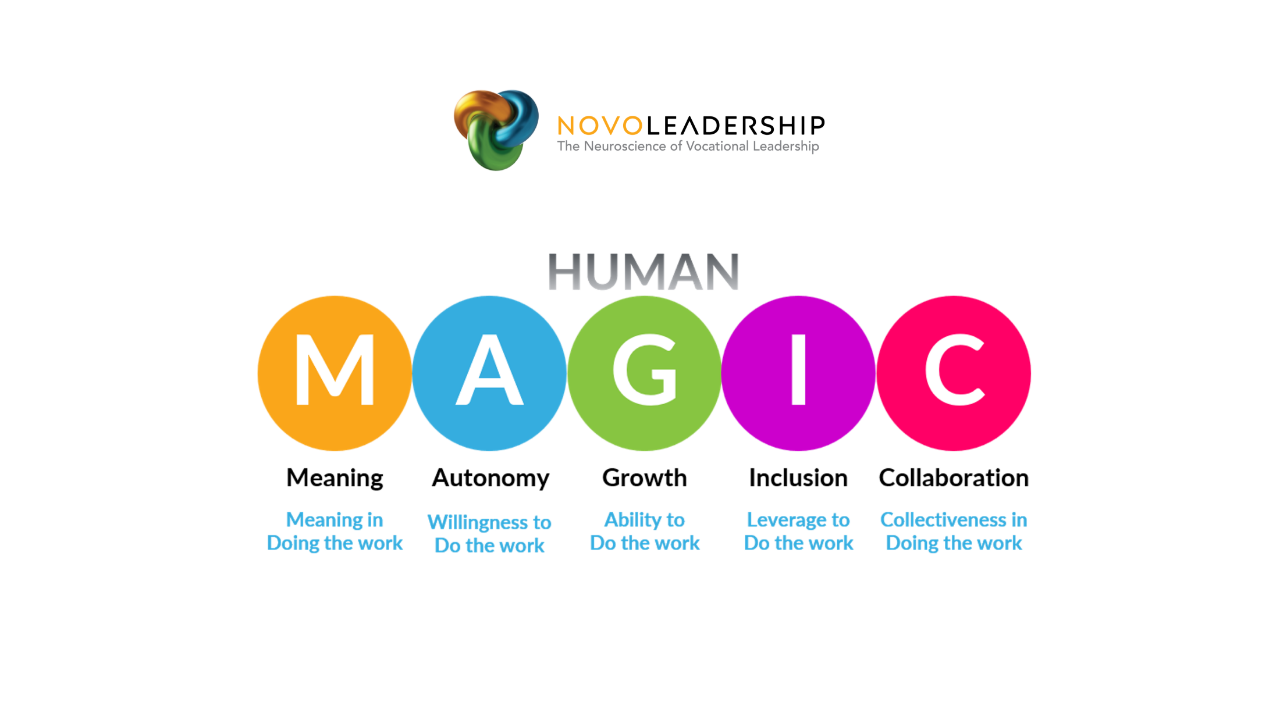
Add a few other important ingredients, and watch the Human MAGIC™ happen.
Stay connected with us
for knowledge sharing updates!
Join our mail list to receive the latest Business & Leadership research, advancements & updates from our team and neuroscience community.
Don't worry, your details are safe, we will never share or sell your information, for any reason. You can unsubscribe at any time.
